 English


CAMINO-2
Scaling shared automated vehicles for sustainable & resilient public transport in NWE
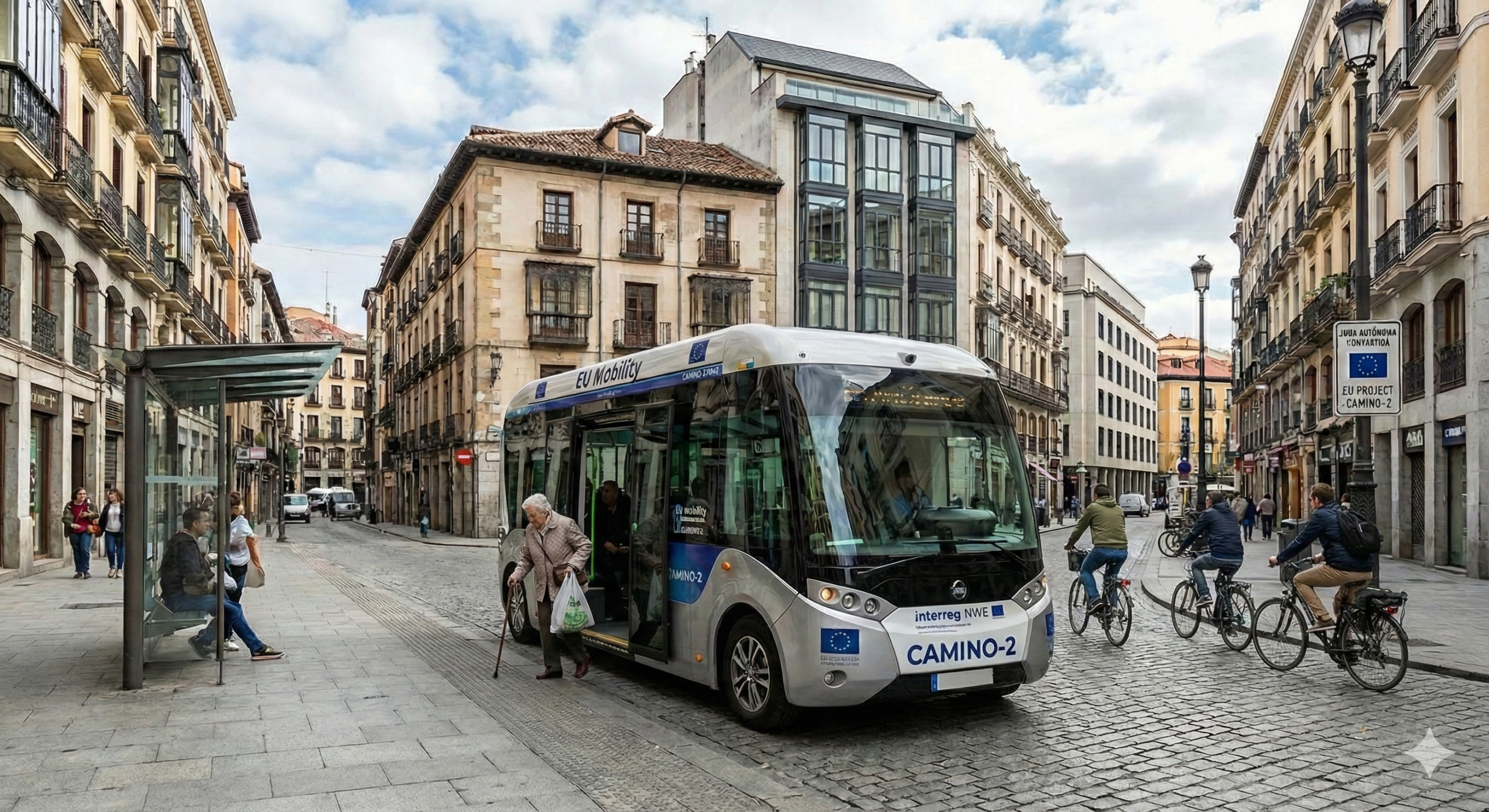
Objective of the project
CAMINO-2 ouvre la voie à une nouvelle ère de mobilité publique inclusive et automatisée en Europe du Nord-Ouest, centrée sur les citoyens pour répondre aux divers besoins de mobilité de la région.
Transport organising authorities (TOAs) and transport operators (TOs) are struggling to maintain services in rural areas and functional urban areas (FUAs) due to rising costs, fluctuations in demand and a shortage of drivers across the EU. The Draghi 2024 report cites shared autonomous vehicles (SAVs) as a flexible, low-emission solution, but their adoption remains hampered by outdated public-private partnerships (PPPs), low public engagement and limited organisational capacity. Without a ‘strong impetus’ for SAVs (Von der Leyen, 2025), the EU risks falling behind the US and China, where robotaxis are already operating in more than 15 cities (Waymo: 250,000 journeys per week in 2025).
CAMINO-2 bridges this gap between strategy and practice. Building on the AV strategies of CAMINO-1, it focuses on operational adoption to plan, test and deploy large-scale, viable AV solutions in north-western Europe. Ten partners from the seven regions of north-western Europe will:
– Co-develop an SAV Service Action Plan (SAV-BAP): a flexible, adaptable planning model enabling PTAs/PTOs to create their own local action plans, in collaboration with more than 35 members of the SAV Innovation Alliance.
– Validate the BAP in four living labs, testing SAV technologies and PPP models in various contexts (rural, suburban and metropolitan areas, and automated depots) via a quadruple helix approach. The results will feed into the SAV toolkit (SAV-IT), a practical guide to procurement, operation and legal frameworks.
– Accelerate adoption through an ambassador programme training seven external organisations in the BAP and IT, and creating a network of qualified regional multipliers.
CAMINO-2 is paving the way for a new era of inclusive, automated public transport in North-West Europe, centred on citizens to meet the region’s diverse transport needs.
Contribution of Multitel
As the project’s Lead Partner, Multitel provides overall coordination and management, ensuring the consortium achieves its objectives on time and within budget. Leveraging its extensive experience in leading complex EU projects, Multitel is responsible for all administrative, legal, and financial management, including all reporting to the Interreg NWE Joint Secretariat. It will centrally coordinate dedicated external support for project management and communication, allowing partners to focus their capacity on project content. Multitel will chair the Project Management Team (PMT), driving the project’s operational progress and risk management.
Also, Multitel is a key Technical Partner, providing expertise in AI, data systems, and simulation throughout the project.
In WP2, Multitel’s contributes to the generation of high-quality, comparable data from the Living Labs. It will lead the design and implementation of the Unified Monitoring & Data Collection Framework (A2.3), a harmonised methodology for all 4 LLs. During pilot operations (A2.2), Multitel will provide technical support on sensor integration and will deploy its AI models to analyse real-time data for demand prediction and anomaly detection. This work informs their work on a key technical module for the SAV-Implementation Toolkit (SAV-IT) on leveraging AI and simulation for scalability (A2.5).
In WP3, Multitel leads the project’s efforts to scale its results. As the leader of WP3, Multitel takes responsibility for managing the transparent, NWE-wide open call and selection process for the 7 Ambassador organisations (A3.2). During the training delivery (A3.3), Multitel will provide its AI-based simulation modules, allowing Ambassadors to test the operational readiness and scalability of their own local action plans in a virtual environment.
In this dual role, Multitel guarantees professional project management and the technical excellence required to deliver innovative, data-driven SAV solutions for NWE.
Applications
PTAs and PTOs across NWE are facing significant challenges in providing sustainable public transport, including rising costs, fluctuating demand and a severe EU-wide shortage of 275,000 bus drivers. These challenges are threatening the viability of services and exacerbating territorial disparities in rural and functional urban areas (FUAs). Mario Draghi’s 2024 report and the EC’s Expert Group on Urban Mobility both identify SAVs as a key solution. However, deployment is being held back by a fragmented regulatory landscape.
National frameworks differ wildly: For example, Germany’s Autonomous Driving Act permits Level 4 operation in designated zones, whereas other NWE regions lack even the most basic authorisations for driverless pilot schemes. This creates concrete barriers: a safety validation or testing framework accepted in the Netherlands is often not recognised in France, forcing PTAs to repeat costly certifications. Furthermore, different liability models and data governance protocols (e.g. different interpretations of the GDPR regarding vehicle-to-infrastructure data) prevent manufacturers from developing ‘off-the-shelf’ solutions, which makes cross-border expansion extremely costly.
CAMINO-2’s transnational approach is essential in order to:
– harmonise testing and safety requirements to create a unified path for vehicle type-approval across the NWE region;
– clarify cross-border liability and data sharing to reduce risk for the private sector;
– aggregate demand to reduce per-unit costs for PTOs by creating a stable, multi-region market;
– pool innovation costs to ensure that a validated ‘SAV-IT’ blueprint can serve both dense hubs (e.g. Île-de-France) and flexible on-demand zones (e.g. Helmond). This ‘big push’, aligned with the 2025 EU Automotive Action Plan, will ensure that the NWE region remains competitive while preventing regional mobility poverty.
Coordinator
- Multitel